Advertisements, brochures, mailings and trade fairs are expensive. Marketing personnel are under constant pressure to justify these costs, a challenge accentuated by the fact that the success of these endeavors is notoriously difficult to calculate. Of course, one can measure the response rate to something like a newspaper advertisement, but questions such as whether more potential customers could have been reached using some other method often linger.
A seemingly trivial question: How many potential customers do you have?
Suppose, for example, that a large furniture store wishes to raise its regional visibility through newspaper advertisements or mailings. Point-of-sale studies show that customers tend not to be willing to drive more than one hour for shopping-related purposes. This raises the seemingly straightforward question of how many households are located within a 60-minute radius of the furniture store. In other words, how large is the potential customer base comprising the target group in question?
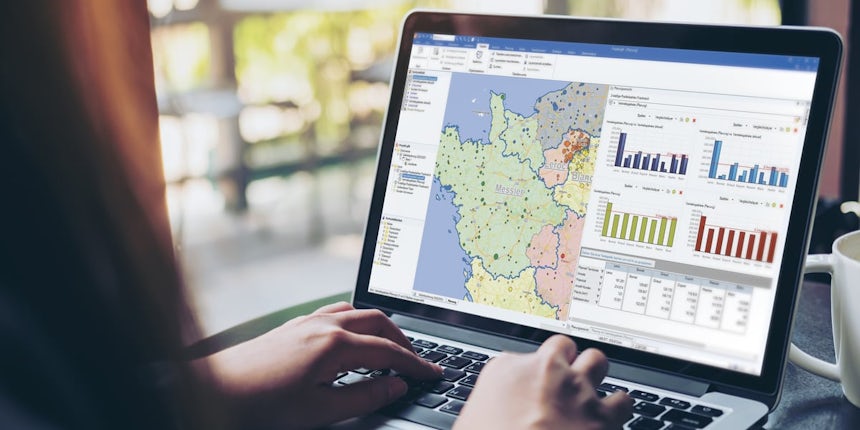
With a geomarketing approach, this otherwise difficult-to-answer question is easily tackled. For example, using the geomarketing software application RegioGraph, you can create drive-time zones with a few clicks of the mouse. You can then calculate and display the population figures, household numbers and many other details for these zones. Only after using this approach to arrive at the number of potential customers will you have a solid foundation for accurately assessing your target groups, growth potential and marketing budget. The benefit of geomarketing lies not simply in coming up with accurate numbers, but also in the ability to illustrate these results on digital maps. The combination of these two elements makes it easy to identify regions with especially high concentrations of your target groups.
Maps as a means of communication between management, sales and marketing
The term "transparency" is frequently cited with regard to fostering clarity and understanding among management, sales and marketing teams. With the help of high-quality digital maps, marketing divisions no longer have to settle for vague speculations about the success of their campaigns. Digital maps can reveal, in one glance, the regional profile of the areas that delivered the highest response rates, such as, for example, those in which mid-level income groups dominate.
Assume that a mailing of 500,000 brochures is planned within a catchment area of 2.5 million households. Using a geomarketing approach, the company in question can concentrate its mailings primarily in those sub-regions where its main target group - mid-level income-earners - resides. This ensures the best possible response with the resources at hand. The maps provide a digital snapshot of the response rates and target group locations at any point in the process, making them ideal reference points to pass on to management.
Replace best guesses with solid science
Geomarketing facilitates better decision-making by providing marketing teams with fact-based analyses visualized on digital maps. This acts as a corrective to unrealistic goals and expectations, while stimulating insights about how and where to realize untapped potential. Multiple factors can be illustrated simultaneously, including areas of opportunities and the presence and impact of the competition in a given region. The latter often sheds light on why a company enjoys market dominance in some areas, while struggling in others.
Put simply, geomarketing produces results that guide companies to more informed courses of action. Returning to the furniture store example, a geomarketing approach highlights the specific geographic regions where a marketing campaign is most likely to yield fruit. This increases the response rate, which in turn translates to a more lucrative campaign!
Locate target groups and measure success with geomarketing
Geomarketing is a highly efficient tool for carrying out targeted marketing actions. It supports marketing teams across the full range of their tasks, from the creation of an advertising campaign to the measuring of response rates. Geomarketing also serves as a versatile channel of communication between management, sales and marketing personnel.